The next book I decided to pick was Playing to Win: How Strategy Really Works by A.G. Lafley, Roger L. Martin. This book is considered as one of the best book on strategy, how to think about it and how to go ahead and implement it.
Who is this book for?
This book is a must read for budding CXO's. It also is a good read for people who generally want to understand how to think about strategy and how to go about implementing it.
Usual Disclaimer
This post is by no means a summary of the book, the notes mentioned here are extracts from the book. If you find these interesting, please pickup a copy of the book and give it a go.
Book Notes
Introduction
Strategy is about making specific choices to win in the marketplace. It therefore requires making explicit choices - to do some things and not others - and building a business around those choices. In short, strategy is choice.
More specifically, strategy is an integrated set of choices that uniquely positions the firm in the industry so as to create sustainable advantage and superior value relative to competition.
- A mission or a vision statement.
- A plan
- An optimisation of status quo.
- A best practice.
It is natural to want to keep options open as long as possible, rather than closing off possibilities by making explicit choices. But it is only through making and acting on choices that you can win. Yes, clear, though choices force your hand and confine you to a path. But they also free you to focus on what matters.
Strategy Is Choice
A company needs to have people that have clear and defined approach to strategy, a thinking process that enables individual managers to effectively make clearer and harder choices.Strategy can seem mystical and mysterious. It isn't. It is easily defined. It is a set of choices about winning. Again, it is an integrated set of choices that uniquely positions the firm in its industry so as to create sustainable advantage and superior value relative to the competition.
Specifically strategy is the answer to the five interrelated questions:
- What is your winning aspiration?
- The purpose of your enterprise, its motivating aspiration.
- Aspirations are statements about the ideal future. At a later state in the process, a company ties to those aspirations some specific benchmarks that measure progress towards them.
- Where will to play?
- A playing field where you can achieve that aspiration
- It represents the set of choices that narrow the competitive field.
- How will you win?
- The way you will win on the chosen playing field.
- This choice is intimately tied to the where to play choice.
- Organisation must decide what will enable it to create unique value and sustainably deliver that value to consumers in a way that is distinct from the firm's competitors.
- What capabilities must be in place?
- The set of systems and measures that enable the capabilities and support the choices.
- This question relates to the range and quality of activities that will enable a company to win where it chooses to play. Capabilities are the map of activities and competencies that critically underpin specific where to play and how to win choices.
- What management systems are required?
- The systems and measures that enable the capabilities and support the choices.
- These are systems that foster, support and measure the strategy. The systems need to ensure that choices are communicated to the whole company, employees are trained to deliver on choices and leverage capabilities, plans are made to invest in and sustain capabilities over time and the efficacy of the choices and progress towards aspirations are measured.
These choices and the relationship between them can be understood as a reinforcing cascade, with the choices at the top of the cascade setting the context for choices below and choices at the bottom influencing and refining the choices above.
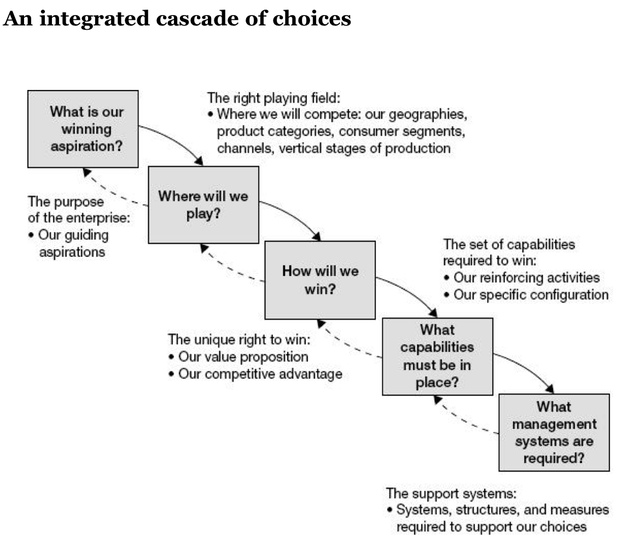 |
What Is Winning?
Aspirations are the guiding purpose of an enterprise. The first box of the strategic choice cascade defines the purpose of your enterprise, its guiding mission and aspiration, in the strategic terms. What does winning look like for this organisation? What, specifically, is its strategic aspiration? These are the foundation of your discussion of strategy.Winning is worthwhile; a significant proportion (and often disproportionate share) of industry value-creation accrues to the industry leader. But winning is also hard. It takes hard choices, dedicated effort, and substantial investment. Lots of companies try to win and still can't do it. When a company sets out to participate, rather than win, it will inevitably fail to make the tough choices and the significant investments that would make winning even a remote possibility.
Desire to win spurs a helpfully competitive ind-set, a desire to do better whenever possible. Winning aspiration should be crafted with the customer explicitly in mind.
Looking at the best competitor, no matter which company it might be, provides helpful insights into multiple ways to win. Who really is your best competitor? More importantly, what are they doing strategically and operationally that is better than you? Where and how do they outperform you? What could you learn from them and do differently?
Where to Play
The choice of where to play defines the playing field for the company. It is a question of what business you are really in. It is a choice about where to compete and where not to compete. Understanding this choice is crucial, because the playing field you choose is also the place where you will need to find ways to win. Where-to-play choice occur across a number of domains:- Geography: In what countries or regions will you seek to compete?
- Product type: What kinds of products and services will you offer?
- Consumer segment: What groups of consumers will you target? In which price tier? Meeting which consumer needs?
- Distribution channel: How will you reach your consumers?
- Vertical stage of production: In what stages of production will you engage?
A choice to serve everyone everywhere - or to simply serve all comers - is a losing choice. Choosing where to play is also about choosing where not to play.
You should avoid three pitfalls when thinking about where to play.
- Refuse to choose: Attempting to play in every field all at once
- Focus is crucial winning attribute. Attempting to be all things to all consumers tends to result in underserving everyone.
- Attempt to buy your way out of an inherited and unattractive choice.
- Companies often attempt to move out of an unattractive game and into an attractive one through acquisition. Unfortunately, it rarely works.
- Accept a current choice as inevitable or unchangeable.
- It is tempting to think that you have no choice in where to play, because it makes for a great excuse for mediocre performance.
Giving in to any one of these temptations leads to weak strategic choices and often to failure.
It can be easy to dismiss new and different Where-to-play choices as risky, as a poor fit with the current business, or as misaligned with core capabilities. And t is just as easy to write off an entire industry on the basis of the predominant where-to-play choices made by the competitors in that industry. But sometimes, you must dig a bit deeper - to examine unexpected where-to-play choices from all sides - to truly understand what is possible and how an industry can be won with a new place to play.
How to Win
Where to play is half of the one-two punch at the heart of strategy. The second is how to win. Winning means providing a better consumer and customer value equation than your competitors do, and providing it on a sustainable basis.In cost leadership, profit is driven by having a lower cost structure than competitors. While all companies make efforts to control costs, there is only one low-cost player in any industry. Having lower costs than some but not all competitors can enable a firm to stick around and compete for a while. But it won't win. Only the true low-cost player can win with a low-cost strategy.
The alternative to low cost is differentiation. In a successful differentiation strategy, the company offers products or services that are perceived to be distinctly more valuable to consumers than are competitive offerings, and is able to do so with approximately the same cost structure that competitors use.
All successful strategies take one of these two approaches, cost leadership or differentiation. Both of them can provide to a company a greater margin between revenue and costs that competitors can match-thus producing a sustainable winning advantage. Competitive advantage provides the only protection a company can have.
Where-to-play and how-to-win choices do not function independently; a strong where-to-play choice is only valuable if it is supported by a robust and actionable how-to-win choice.
Play to your Strengths
Most corporate mergers fail to create value. The bigger the deal, the less likely it seems to produce success. Any acquisition should satisfy these criteria
- Growth accretive - in a market that was growing (and likely to continue growing) faster than the average in its space and in a category or segment, geography or channel.
- It should be structurally attractive - a business that tended to have gross and operating margins above the industry or company average.
The acquisition is only really successful if the acquirer is a better owner of the business than either the previous owner or the company as an independent company.
An organisations core capabilities are those activities that, when performed at the highest level, enable the organisation to bring its where-to-play and how-to-win choices to life.
When thinking about capabilities, you may be tempted to simply ask what you are really good at and attempt to build a strategy from there. The danger of doing so is that the things you're currently good at may actually be irrelevant to the consumers and in no way confer a competitive advantage. Rather than starting with capabilities and looking for ways to win with those capabilities, you need to start with setting aspirations and determining where to play and how to win. Then, you can consider capabilities in light of those choices. Only in this way can you see what you could start doing, keep doing and stop doing in order to win.
Manage What Matters
Without supporting structures, systems and measures, strategy remains a wish list, a set of goals that may or may not ever be achieved. To truly win in the marketplace, a company needs a robust process for creating, reviewing and communicating about strategy; it needs structures to support its core capabilities; and it needs specific measures to ensure that the strategy is working. These management systems are needed to complete the strategic choice cascade and ensure effective action throughout the organisation.
Strategy is formulated at all levels of the organisation, and to be successful it needs to be clearly communicated at all levels as well. The businesses must communicate their strategies to management, but management must also communicate the company-level choices to the whole organisation. The challenge is to find simple, clear and compelling ways to do so. A massive binder to thick power point deck won't rally an organisation. Best way to communicate the strategy is by communicating its essence broadly and clearly. Ask, what are the critical strategic choices that everyone in the organisation should know and understand?
Every company needs systems to support the building and maintenance of its key capabilities. The capabilities are so important to competitive advantage that ta company needs to install systems to ensure that these capabilities are properly nurtured.
If aspirations are to be achieved, capabilities developed, and management systems created, progress needs to be measured. Measurement provides focus and feedback. Focus comes from an awareness that outcomes will be examined, and success or failure noted, creating a personal incentive to perform well. Feedback comes from the fact that measurement allows the comparison of expected outcomes with actual outcomes and enables you to adjust strategic choices accordingly.
Think Through Strategy
For any company, there are many possible strategic choices that could be selected, an almost infinite amount of data that could be churned, and a wide array of strategic tools that might be brought to bear on the problem. It can be overwhelming, even paralysing. The bad news is that there is no simple algorithm for choice. The good news is that there is a framework that can give you a place to start.
It is essential to define a winning aspiration up front. Without having an initial definition of winning, it is difficult to assess the value of any subsequent choice. Strategy is an iterative process, and you'll need to return to refine your winning aspiration in context of the subsequent choices.
Then consider the real work of strategy as beginning with where to play and how to win. These are the choices that actually define what you will do, and where you will do it, so as to generate competitive advantage. There are four dimensions you need to think about to choose where to play and how to win:
- The industry. What is the structure of your industry and the attractiveness of its segments?
- Customers. What do your channel and end customers value?
- Relative position. How does your company fare, and how could it fare, relative to the competition?
- Competition. What will your competition do in reaction to your chosen course of action?
These four dimensions can be understood through strategy logic flow. It poses 7 questions across the four dimensions.

To determine where to play, you must ask, what might be the distinct segments of the industry in question. Which segmentation scheme makes the most sense for the given industry today, and what might make sense in the future?
Once you have articulated existing and new segments, you must understand the structural attractiveness of the different segments. A firm would want to play in segments that have higher profit potential based on their structural characteristics.
Regardless of whether a firm wishes to be a cost leader or a differentiator, it needs to understand precisely what customers value.
Understanding end consumers is a challenging thing, because you can't simply ask what they want, need and value. Recall Henry Ford's famous quip that if, at the dawn of the automotive industry, he'd asked consumers what they wanted, they would have said, "A faster horse". To understand the consumer value equation, you must truly get to know your consumers - to engage with them beyond the quantitive survey, through deeper, more personal forms of research - watching them shop, listening to their stories, visiting them at home to observe how they use and evaluate your products. Only through this kind of deep user understanding can you hope to generate insights about where to play and how to win.
To make good choices, you need to make sense of the complexity of your environment. The strategy logic flow can point you to the key areas of analysis necessary to generate sustainable competitive advantage.
- First, look to understand the industry in which you play (or will play), it's distinct segments and their relative attractiveness.
- Next, turn to customers. What do channels and end consumers truly want, need and value - and how do those needs fit with your current or potential offerings?
- Next, answer the question what are your capabilities and costs relative to the competition? Can you be a differentiator or a cost leader?
- Finally, Consider competition; what will your competitors do in the face of your actions?
Working through the framework takes both patience and imagination. It also takes teamwork. Any new strategy is created in a social context - it isn't devised by an individual sitting alone in an office, thinking his or her way through a complex situation. Rather, strategy requires a diverse team with the various members bringing their distinct perspective to bear on the problem.
Shorten Your Odds
In strategy, there are no absolute answers or sure things, and nothing lasts forever. Having a clear definition of winning, a robust analytical framework such as the logic flow, and a thoughtful review process can help organise thinking and improve analysis, but even still, a successful outcome is not guaranteed. In the end, building a strategy isn't about achieving perfection; it's about shortening your odds.
Asking a single question can change everything: what would have to be true? This question helpfully focuses the analysis on the things that matter. It creates room for inquiry into ideas, rather than advocacy of positions. It encourages a broader consideration of more options, particularly unpredictable ones.
Until a real choice is articulated, team members can't understand cognitively or feel emotionally the consequences of the different ways to resolve the issue.
Next tasks is to broaden the list of possibilities. The objective in this step is to be inclusive rather than restrictive of the number and diversity of possibilities on the table.
Next, team needs to reverse engineer the logic of each possibility. That is, it needs to specify what must be true for the possibility to be terrific choice.
The fourth step in the process constitutes a 180 - degree flip. Now you can cast a critical eye on the conditions your team has identified. The ask is to assess which of the conditions your team believes are the least likely to hold true.
Once key barrier conditions are identified, they must be tested in ways the entire group will find compelling. A test may involve surveying a thousand consumers or speaking to only one supplier.
The test design process leads to the actual testing phase and the analysis of results. First test the things you are most dubious about. Take the condition the team feels is the least likely to hold up, and test it first.
The choice making step becomes simple and even anticlimactic. The team needs only to review the test results and make the choice dictated by the pattern of results.
The Endless Pursuit of Winning
It's not getting any easier to win in the real world. Growth is slowing, and the pace of change is increasing. As the world continues to globalise, companies face more competition for customers and consumers than ever before.
There is no perfect strategy - no algorithm that can guarantee sustainable competitive advantage in a given industry or business. But there are signals that a company has particularly worrisome strategy.
- The do-it-all strategy: Failing to make choices, and making everything a priority.
- The Don Quixote strategy: Attacking competitive walled cities or taking on the strongest competitor first
- The waterloo strategy: Starting wars on multiple fronts with multiple competitors at the same time.
- The something-for-everyone strategy: Attempting to capture all consumer or channel or geographic or category segments at once.
- The dreams-that-never-come-true strategy: Developing high-level aspirations and mission statements that never get translated into concrete where-to-play and how-to-win choices, core capabilities, and management systems.
- The program-of-the-month strategy: Settling for generic industry strategies, in which all competitors are chasing the same customers, geographies, and segments in the same way.
There are some common signs that a winning strategy is in place:
- An activity system that looks different from any competitor's system
- Customers who absolutely adore you, and non-customers who can't see why anybody would buy from you.
- Competitors who make a good profit doing what they are doing.
- More resources to spend on an ongoing basis than competitors have.
- Competitors who attack one another, not you.
- Customers who look first to you for innovations, new products, and service enhancements to make their lives better.
Even companies with these telltale signs shouldn't rest, because no strategy lasts forever. Ideally, companies should see strategy as a process rather than a result - adapting existing choices before business and financial results start to turn down.

